
I did IMO 2017 P2 with my friends yesterday. Now I would like to share my thoughts on this problem.
Problem: Let  be the set of real numbers. Determine all functions
  such that, for any real numbers
  and
and  ,
,
![\[ f(f(x)f(y))+f(x+y)=f(xy)\]](https://zivmaths.com/wp-content/ql-cache/quicklatex.com-f5e345f20ee30aaf550bbfaaad4747d1_l3.png "Rendered by QuickLaTeX.com")
The initial step must be taking certain values, testing its properties and then start guessing the solution. Well, obviously, the constant function  is a solution to the problem.
Now we can try to take  , giving us
(1) 
and
(2) 
Now if we take  , we could get
(3) 
 appears on both side, and it is quite hard to analyze it. What if we already know the value of ? Suppose that
  , then
  , so , giving us the trivial solution. Now suppose that
  , notice that if we replace
  with
with  , then is also a solution. That means we can only consider the case where
  .
.
Now we are stuck. Maybe we should try to get more informations. One strategy we often use involving solving functional equations is cancelation. Let  , we can replace
  . Plugging in, we get
(4) 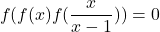
This result could be pretty useful, as we can use it to analyze the zeros of  . We know that there must have at least one zero. Now suppose that for some
  ,
,  , then
  , which is a contradiction. That means if we have a zero, then it must be
  . Therefore,
  , and
, and  whenever
  .
.
Now we could more or less take a guess. It is impossible that has a degree greater than one, and it is very likely that it is a linear function, which is  . We proceed with this conjecture.
Having , we can plug  into (4). We derive
(5) 
This gives us  . So we could try more values. Taking
  , we get
(6) 
so
(7) 
We can also take , we get
(8) 
so
(9) 
Viewing this composite function, we can use the traditional method.
(10) 
The solution could be very similar to our conjecture. If  , then . That means if we can prove injection, then we are done!
This could be a hard part. We go back to our problem
(11) 
Suppose that  , we need to pick specific and to give some useful information. Seeking relation to zero, we want
  . So let
  and
and  . This is achievable, since by our previous result,
  . If we want the determinant
  , we can shift
  and
and  so that is large enough. Finally, we get
(12) 
So  or
or  . Therefore, or
  , giving us
  , and we complete the proof.

Leave a Reply